Showing posts with label Living in Kuala Lumpur. Show all posts

Saturday, November 26, 2016

High-Rise Housing Proposal in Danau Kota, Kuala Lumpur


This was a proposal to redevelop about over 13 acres of land in Setapak, Kuala Lumpur which contains a large mining pool and which functions as a water retention pond. About half of the plot is below water surrounded by about 6.5 acres of land that can be developed.


The location is within a well built up area near a major road, high-rise apartment and a commercial centre. The client wanted to realize the value to the land by increasing placing serviced apartments and commercial on it while converting the pond into a public park.

The Brief

We proposed to meet the potential demand for high-end serviced apartments with club and hotel standard amenities on the land found North of the pond with commercial units along the Southern boundary fronting Jalan Genting Kelang.

The Solution

Five blocks of 30 storey apartments were placed on a 4-storey podium block which houses the apartment facilities and car parking.


The apartments were laid out in a modified split-level arrangement with the living room at the courtyard level, the kitchen, dining and bedroom 3  half a floor above or below it, and the master bedroom, bedroom 2 and bathrooms a full floor above or below the courtyard level.
The Danau Kota proposal was only one of many Honeycomb high-rise proposals.


A Dead End?

Four years after first developing the high-rise honeycomb idea, we had prepared many proposals but none yet had been taken up by any developer. The model that I had pushed, the X-Plan, was perhaps perceived too luxurious in the provision of courtyards. They were always thought of as being most suitable for luxury condominiums. But, my experience and reputation were in affordable housing, not high-end. 

I could only tout the X-Plan as being no more expensive than conventional high-rise designs. And there was uncertainty even in in that: developers can take advantage of the savings from eliminating corridors and providing fewer lifts, but will authorities approve higher densities?

What would be the cost of providing and maintaining the courtyards and the landscaping? Six storeys high, they were open to the sky to allow even grass to grow. But potential clients asked: would driving rain would be a problem? Isn’t a roofed walkway necessary to connect the lift lobby to the unit? At what cost?

And what about the cost of the staircase in each home?

Would the high-rise Honeycomb be suitable for affordable housing in Malaysia?

I did not have the answers at that time. I had to simply accept that the idea wasn’t yet sufficiently compelling. I decided that the best way to progress further was to answer that last question. If the ordinary Malaysian can afford to own a Honeycomb apartment, then it would be compelling.

A tough challenge!.

Thursday, June 18, 2009

Architect vs "Feng Shui Master"

“I won’t believe in feng shui any more after what had happened”, says an architect afflicted with particularly negative elements! This story is yesterday's The Star:

Luck runs out for architect
By YAZREEN HARON


KUALA LUMPUR: He was looking at feng shui to change his luck but the reversal of fortune not only left him RM29,260 poorer but without a girlfriend as well.
When the 36-year-old architect, known only as Ong, bought a house at Lakefield, Sungai Besi, his girlfriend recommended that he consult her feng shui master.

Ong went along with her wishes and soon met the feng shui master who told him that he had a spell of bad luck. The “master” promised to turn his luck around for a fee.

Ong promptly issued a cheque for RM29,260 to cover the feng shui expenses of the “master” who claimed that his services were sought worldwide.

After conducting some rituals at Ong’s new house at 10pm, the “master” told him not to speak of the session to anyone and not to sell the house for the next three years.

The “master” later demanded RM15,000 for an amulet to “protect” Ong and his girlfriend.

But before even receiving the amulet, Ong’s girlfriend told him that it was broken and RM30,000 was needed to replace it.

Feeling suspicious and believing that he had been cheated by the “master” and his girlfriend, Ong refused to pay and soon separated from his girlfriend of five years.

“I won’t believe in feng shui any more after what had happened,” Ong told a press conference organised by MCA Public Services and Complaints Department head Datuk Michael Chong.

“The police will be looking into Ong’s case,” said Chong.

Sunday, May 31, 2009

An Interruption...

I’ve too busy this last two weeks and have not been posting!

My 75 year old father-in-law had to go into hospital. Mr. Ghazali (by coincidence we share the same name)  had had a long history of high blood pressure and asthma, and for a couple of weeks beforehand, suffered from, what were to me, vague symptoms  -  anxiety, shallow breathing, water retention in the legs, sleepiness...

When finally it was decided to take him to hospital, he fell asleep on the way, and finally when he arrived at the hospital, did not wake up. By then his fingers had turned blue.

The immediate cause of the passing out was the high level of carbon dioxide in the blood. This showed in blood tests; drowsiness and bluishness in fingers and toes are common symptoms of CO2 poisoning.

He was put onto a ventilator to help with his breathing.

His other main symptom was difficulty in passing water, coupled with water retention (or oedema). So the doctors put on a catheter to drain away the urine and excess fluids from the body.

Ghazali’s condition looked bleak on the Saturday he was admitted. He was unconscious, was on a ventilator, and his whole body was swollen with oedema. But he responded to the most immediate treatment – the blood CO2 level came down and his swelling subsided and you could see his face and hands becoming wrinkly again. He could have woken up earlier but the doctors thought it better to keep him sedated – the ventilator worked better with the patient in this condition.

By Tuesday he was allowed to wake up and had a brain scan. They found that he had had a stroke!

But in the few days that followed it became apparent that the effects are turning out to be relatively minor. There doesn’t seem to be any sign of incapacity – my father-in-law can still speak and easily move both sides of his face and limbs. This is not what happens in severe cases of stroke. Thank God!

Ghazali can count himself lucky and he can look forward to coming back to our home. But his chronic high blood pressure stays with him. The latest reading was something like 167/65 (against 120/80 normal count). Such a big difference in the systolic (upper) and diastolic (lower) figures is symptomatic of hardened arteries. My wife has high blood pressure too, so I’m pestering her to get it down with diet and exercise, or else she should take medication.

This isn’t architectural blogging as usual, but often life (and death) has a way of intruding.

Tuesday, May 5, 2009

Kuala Lumpur's Commercial Area: Past and Future


This is Kuala Lumpur (KL) towards the end of the 19th Century when it was just a small town with not that many blocks of shop houses.


The main roads led north to Rawang, South-West to Klang, to South-East to Cheras, and West to Ampang.

According to Mr. Ho Chin Soon, "Pudu Village" was so far out of town that civil-servants going there could claim outstation allowance! Of course, Pudu is now considered as part of the inner-city.


The city's commercial activities expanded mainly along the trunk roads towards the North, South_West and South East. The corridor West towards Ampang grew mainly as a residential area.


That is until the 70's (when I was still in school), when private developers turned it into a high-rise commercial district - aptly called the "Golden Triangle". It's pretty built-up now.

As for the future, Ho mapped out the impediments to growth - the swathes of entrenched residential areas, Government owned land and reserves for cemeteries, parks, etc. And the areas left over are the likeliest places for the Golden Triangle to spill over to.


The maps are Ho Chin Soon's, see his excellent website at www.hochinsoon.com/

Sunday, April 26, 2009

Prospects for property in Malaysia


I love maps, but there is another Malaysian who loves them even more. That person is Ho Chin Soon. A valuer by profession, he has made maps his business. But more of that in a later post.

In March , I had the chance tom see him speak at a property exhibition in the Mid Valley Mall in Kuala Lumpur. He talked about the prospect for property market in Malaysia during this global recession.


His message was very simple:

Yes, times are bad in the States with the financial crisis. There is usually a six month delay between happens in the real economy in the US and Malaysia. Seeing that a large part of the crisis in the States has stemmed from a property bubble, how will Malaysia be affected?

In his opinion, the property in Malaysia has been largely flat since the last recession in 1998.He suggests that the local events in the past couple of years had kept down the values of stocks and properties, whilst Singapore and many other countries enjoyed a boom.


He pointedly drew contrast the large rises in the rents and prices of properties in Singapore in the last decade and the measly increases here.


There are exceptions of course, and the development around KLCC is one. There is at least least one project where work has been deferred indefinitely.


“No bubble here” is his conclusion. That is not to say that we are immune to financial stress; certainly the reduction in export incomes will affect the economy. The level of bank’s non-performing loans has not shown a substantial increase. Nor has he noticed an increase in properties for auction. Both these things will take time to work through the system. Prices will fall, but not as much as has fallen in Singapore.

Meanwhile, the main bargains to be had are those on offer from big developers who are keen to unload their unsold properties.


Thursday, May 1, 2008

Lamp Posts in Malaysia


libromanic.com

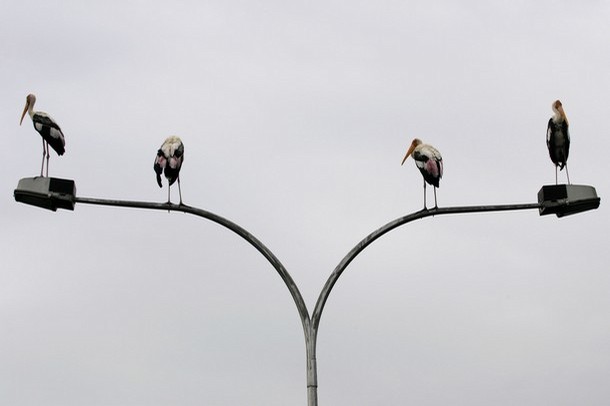
The most beautiful lamp posts in Malaysia can be said to be found in the new administrative capital of Putrajaya. It appears as if every road there must have lamp posts with its own distinctive design.


polytikus.com

But the signature lamp posts along with the signature bridges and buildings, do not make this new city a place that I would like to live in (even if I could afford to buy a decent house there)!


www.daylife.com

For me, the most interesting lamposts are along the Middle Ring Road, alongside Taman Melawati.

On my way home from monthly trips to Kuantan, usually just before dusk, I always look out for big birds that like to perch on the lamp posts along a 2 to 3 kilometer stretch of this road. And I've wondered about them for a long time...


Ani Mardiastuti

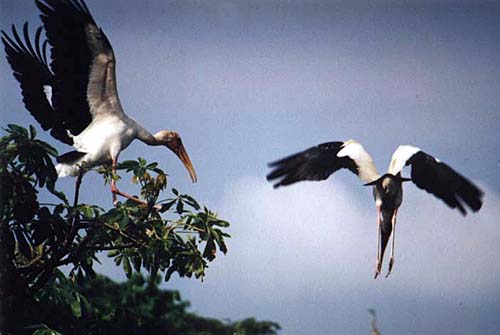
Yesterday was Labour Day holiday. On a family outing to the zoo, I've discovered that they are Milky Storks or 'Burung Upeh Botak' (bald upeh bird). There was a large flock of them on an island in the zoo's lake. They are not fenced in, so sometimes they fly out.

"The globally threatened Milky Stork 'Mycteria cinerea' faces extinction in the wild in Malaysia, according to Yeap Chin Aik of the Malaysian Nature Society.
The species is a predominantly a coastal resident in Indonesia and Malaysia, inhabiting mangroves and adjacent swamps.....(but) these tidal forests are threatened by agricultural conversion and development schemes, particularly large-scale fish farms, tidal rice cultivation, logging and related disturbance".


This bit of information makes me more eager to look out for these birds anytime I'm in the neighbourhood!

Sunday, March 30, 2008

Kuala Lumpur Birds

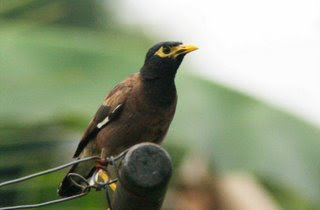
I am lucky that in Kuala Lumpur, I can wake up to the sound of singing birds. Mainly there is the Common Myna. In Malay it is tiong ‘gembala kerbau’ ( ‘buffalo herder’ tiong).


From redzlan.blogspot.com

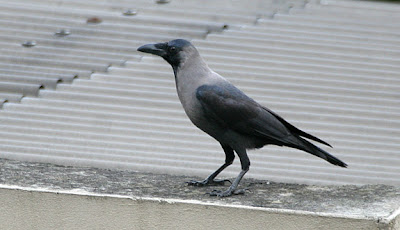
There are also the pestilent crows.


“The crow is an aggressive and opportunistic feeder, and has a devastating impact on indigenous bird populations by eating eggs and chicks, and mobbing other birds that might compete with it. It threatens the local wildlife by preying heavily on frogs, lizards, small mammals, fish, crabs and insects. The crow was introduced to Malaysia as a bio-control agent of rhino beetles in oil palm estates. “
From 10000birds.com

But the Mynas seem to be able to work around the nasty habits of their cousin specie.


From redzlan.blogspot.com

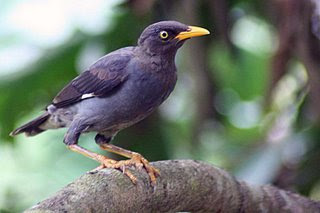
This morning after breakfast, I heard the loud whistles of another bird, the Jungle Myna - tiong ‘sawah padi’ (padi fields tiong) . They are less common, black like crows, but had bright bright eyes and yellow beaks. And they were happy whistling away...

Friday, March 14, 2008

Civets in the City #2


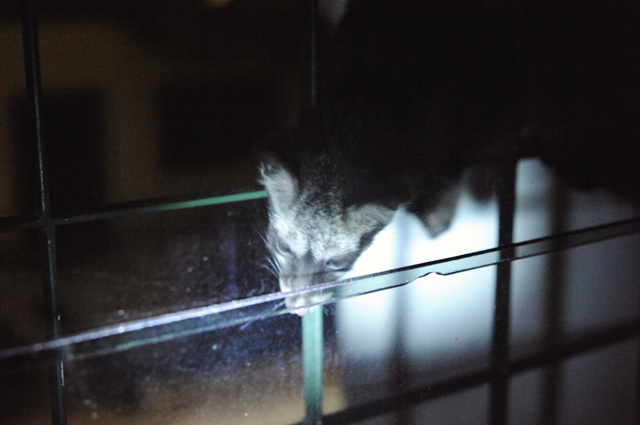
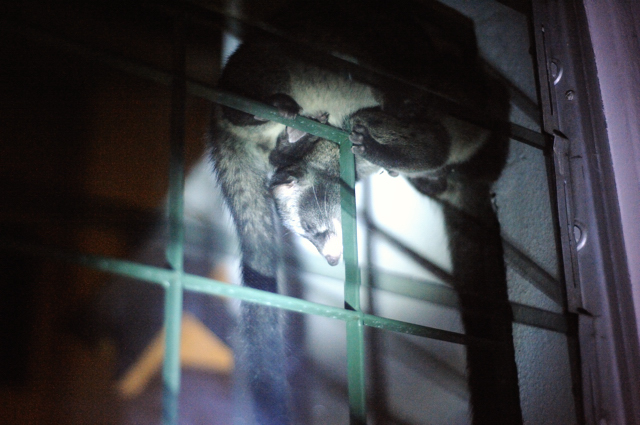
After my “Civets in my Attic” post, I received an email from Colin Chua, a fellow Malaysian living just north of Kuala Lumpur. He sent me a couple of photos of the cubs and wrote:

“I have civets living in my attic too. But my closest encounter occurred early yesterday at about 4am. I was rudely awakened when I heard noises at one of my bedroom windows. When I went to investigate, I was startled when I found a family of four civets outside. Two larger civets which I presume to be the adults were on the roof, whilst the other two smaller civets or pups were hanging or playing on the iron grille”.


I'm interested to explore how far wild animals can co-habit our cities and towns. In the countryside, the fox-like civets are considered as pests because they prey on the chickens. I would like to think that there would be less conflict in urban areas – where humans and civets can adapt to each other.


There are worries, as Colin adds:

“But in the urban environment, I am thinking of the potential threats these civet cats can have on our domesticated animals. My concern arises as I have two little dogs, four cats and a sulphur crested cockatoo. Furthermore, civet cats in China are also believed to be carrying a coronavirus that is very similar to the SARS virus in the faeces and secretions. Here is the link.

Thus, could our urban civet cats be carrying some dangerous diseases too? I really do hope not as I find them kind of cute but nevertheless there is a worry as I have found lots of the civet cat's droppings on my roof”.


It appears that the local ‘squirrel’ or ‘tupai’ has adapted very well to urban habitats, but most experts now come to the conclusion that monkeys don't adapt well to human contact. Are there any wildlife experts out there who can tell us on how to best deal with the civets in town areas?

Thank you very much Colin for the email and photos.

Thursday, March 13, 2008

Monkey Urbanization

At the fringes of the city where we trek and picnic, we often find groups of monkeys. These are long-tailed macaques. They inhabit a wide range of habitats including primary and secondary forest, mangroves, plantations. They are also quite happy in the outskirts of towns and villages. The macaque has a varied diet - fruits, leaves, small mammals and birds, shellfish and crabs. They also love human food!

But when used to human handouts, the cute monkeys become less pleasant. They stop looking for food in the forest and pester humans instead. The aggressive will snatch food away from children; they can get very aggressive.
From ecologyasia

Feeding also results in an unnaturally large monkey group size. A normal group of monkeys in the wild usually has 15-30 members. Groups that are fed by humans can be twice as big or more. More monkeys in a group mean more conflicts between monkeys".

From
Wild Singapore

Recently in Malaysia, the government is considering a culling exercise to curb monkey overpopulation in town areas. There was a report about some of these animals being infected with tuberculosis and the herpes B virus, but experts say that the infected macaques do not pose a danger to the public.


In Singapore, feeding monkeys is a crime: this year a man was fined 4000 Singapore Dollars (USD2900).

More advice from Wild Singapore
  • Do not offer food to the monkeys.
  • Do not bring food and or eat in forested areas.
  • Avoid carrying plastic bags openly in forested areas.
  • Make sure your children are not eating or holding food near monkeys.
  • Dispose your litter into the monkey-proof bins provided. Better still, take your litter out of forested areas with you.


"Don't feed the monkeys: you will do them more harm than good"

Sunday, March 2, 2008

Templar's Park


I was born in Kuala Lumpur (or KL). Except for the time I was studying in the UK, I have lived in this city my whole life. Many people complain that about life in KL but I love it here. Of course there are many things wrong with it, but let me dwell on one positive aspect: its proximity to nature.


Templar's Park is forest reserve with scenic waterfalls less than an hour (20km) from the centre of the city. When I was a small boy in the 60's, my parents would often take the family out there for picnics. Recently I took my small children there.


Its been a long time since we've last been there, and that was because it had become unkempt and dirty; the park department did'nt do a good job. But I was happy to see that its quite clean now. The small entrance and carparking charge was worth it.


You don't get to see wild animals in Malaysian forests,except monkeys. They like to scrounge food from humans, who often oblige. In another post I'll go into the problems that crop up with this human-animal contact.


You might like to look at previous posts about living in Kuala Lumpur..

Monday, February 25, 2008

Jungle Trekking in Kuala Lumpur


Thank god for the steep hilly areas:land much too steep for rubber or oil-palm plantations, or construction. One of the great things about my home-city is how near it is to waterfalls and jungle treks.


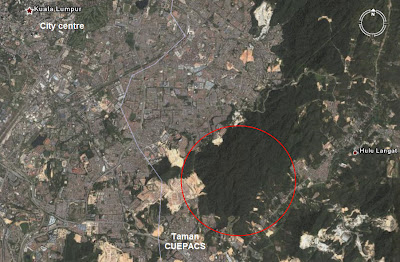
Taman Cuepacs is less than an hour from the city-centre. The housing development there date from the 1970's is rather non-descript: terrace-houses and more terrace houses with some terrace shop-houses for relief. Then there is an imposing high-rise development at a hill-top with some dreamy name like "Venice Hills" or something.


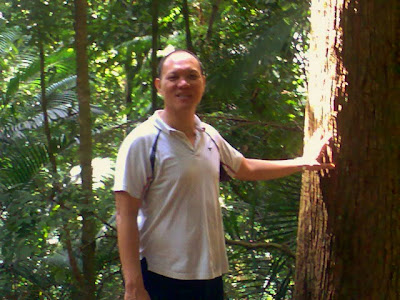
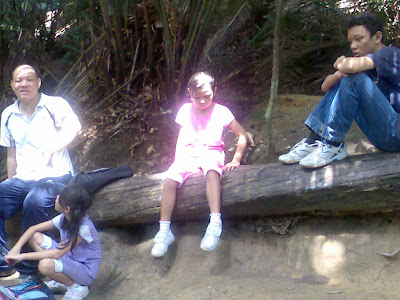
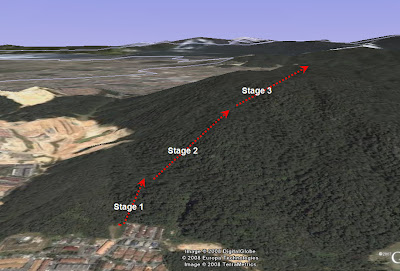
But it is also at the foot of a scrap of hilly forest reserve. The jungle trail here is clearly marked. From a clearing next to a few rows of houses right next to the forest, you first climb up and down a small hill to a little stream. This is stage 1. For Level 2, it gets steep for a good 30 to 45 minute climb. The rest is easier, but I've never gone on past Stage 3. When I brought my family along for a trek it was a bit difficult for the two little girls, age 9 and 10. This is us resting after the steep ascent. Notice that we're not smiling.


But the girls enjoyed it better when we we got back down to the little stream.


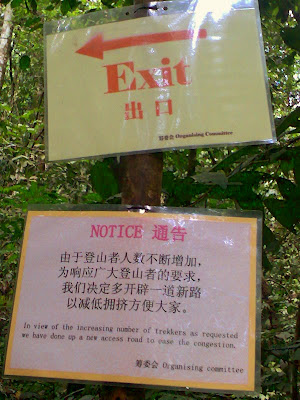
Nature-loving city folks have been trekking through these forests for quite a while. Some of them had got together keeping the trails clean, placing signposts on them, put up simple toilets and changing room at a clearing where trekkers can park.


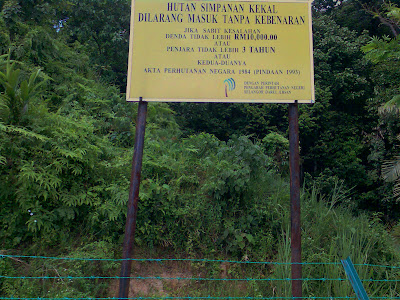
But sometimes, citizen self-organization and people enjoying nature is too much for officialdom. The State Forest Department has recently spent good tax-payers money to put up fence around where trekkers usually start their walks and put up a signboard threatening "3 years jail or RM10,000 (USD 3,000) fine, or both" for tresspassing!