Showing posts with label Children Growing Up. Show all posts

Tuesday, October 4, 2016

2.1 From Kampongs to Terrace Houses

In Malaysia since over 50 years ago, people started migrating into towns and cities. Mainly they moved from thatched-roofed kampong houses built on stilts into modern terrace houses which came ready with electricity, piped water and indoor sanitation.

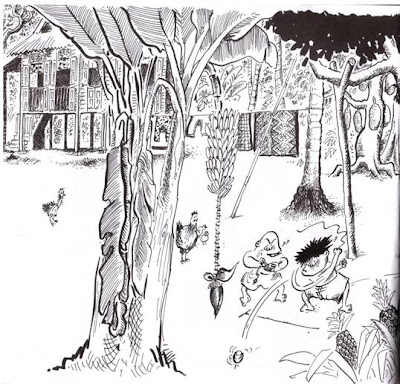
But the traditional kampong houses that were left behind had much to be counted in their favour (figure 1). Kampong houses were close to nature and open spaces, children had lots of friends to play with and to explore together the world around them. Set in small villages, the community was small in number but strong in spirit.


Figure 1 A kampong in the 60's

In contrast, terrace houses (figure) are lined up along grid-lines with 40’-50’ (12m-15m) service roads in front with much smaller back lanes and side lanes. My family home is a terrace house at the edge of Kuala Lumpur when it was still just a large town, close to nature and open spaces, among neighbours that you knew. I had lots of friends, together we explored the world around us. It was not exactly like Lat's boyhood in "Kampong Boy", but close. However that was not how my children grew up.


Figure 2 Terrace houses
With growing population and urban migration, more people are crowded into cities. The road in front of the terrace houses may have once functioned as a good social space, safe even for children to play on. However, as cars became more prevalent – this social space on the street disappeared. 

Communal areas for schools, civic and religious buildings as well as open areas for playgrounds and parks may be provided in new housing estates. But despite these amenities, the design of many housing estates does not really meet the practical needs of raising a family.

Worried about safety from speeding cars and strangers, children are cooped up indoors. Mothers become full time drivers, taxying their children from school to tuition to classes to play dates. There is scant opportunity for children to play outside on their own as they once did in the kampongs. Living in terrace houses has become little better than living in high-rise apartments. 

It’s a price to pay for urbanization, which has happened not only in the cities but also in the countryside, where new housing estates have sprouted around the edges of once small towns. 

It's possible to buy homes with lush landscape and club facilities, in secured and gated enclaves, but most people would never ever be able to afford them. My father bought our home, a terrace house, in 1968 for only RM13,000. Of course, prices have been going up and up, because of higher costs of labour and materials, but mainly because of the spiralling cost of a depleting resource for growing cities - land.


Sunday, March 2, 2008

Templar's Park


I was born in Kuala Lumpur (or KL). Except for the time I was studying in the UK, I have lived in this city my whole life. Many people complain that about life in KL but I love it here. Of course there are many things wrong with it, but let me dwell on one positive aspect: its proximity to nature.


Templar's Park is forest reserve with scenic waterfalls less than an hour (20km) from the centre of the city. When I was a small boy in the 60's, my parents would often take the family out there for picnics. Recently I took my small children there.


Its been a long time since we've last been there, and that was because it had become unkempt and dirty; the park department did'nt do a good job. But I was happy to see that its quite clean now. The small entrance and carparking charge was worth it.


You don't get to see wild animals in Malaysian forests,except monkeys. They like to scrounge food from humans, who often oblige. In another post I'll go into the problems that crop up with this human-animal contact.


You might like to look at previous posts about living in Kuala Lumpur..

Tuesday, October 23, 2007

Children and Safety from Crime

Last September in Malaysia, a ten year old girl by the name of Nurin, who had been missing a month before, was found dead. She had been abducted. Police found evidence of sexual abuse and torture. They lived in what I believe to be one of the better “low-cost” housing schemes in Kuala Lumpur. She had gone out alone just after dark – she popped out to go to the night-market just downstairs from her flat. This was a tragedy that affected the whole country, and an event that I was afraid would result in an over-reaction.

At about the same time a group of experts in Britain wrote a letter to the Daily Telegraph bemoaning the “loss of childhood”. Among other factors, one cause of this was said to be over-protective parents anxious about dangers from traffic and crime. I personally disagree with the nation’s leading newspaper, Straits Times splashing the picture of the dead girl on its front page. Yet the dangers are real, even if it is said to be sensationalized.

I agree with the experts in Britain; I would prefer my children to have the freedom to explore the areas outside the home. But my wife disagrees. I grew up fine in Kuala Lumpur - but in the 60’s and 70’s it was a much smaller city. So for now at least, my wife has the upper hand.

Are cities inevitably unsuitable for raising a family? The supporters of the “New Urbanism” and “Smart Growth”, movements in that champion compact city development as opposed to sprawling suburb development have had a tough time on this issue. Lewis Mumford, an early critic of the suburb based on mass car ownership, decried suburbs as being “only good for raising children”. Their opponents sarcastically reply that the people who are so dismissive of suburbs tend to be childless or gay. The arguments from both sides appear to be true. Indeed, the debate has become an ideological affair.

Safety from traffic is only one aspect of aspect of the issue of safety for children in urban areas, and I’ve dealt with this in an earlier post on Delft. This appears to be a successful model that can be emulated. The other is of course - safety from crime – and the concept of “Defensible Space” is a good place to start.
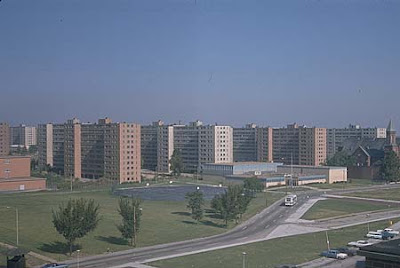

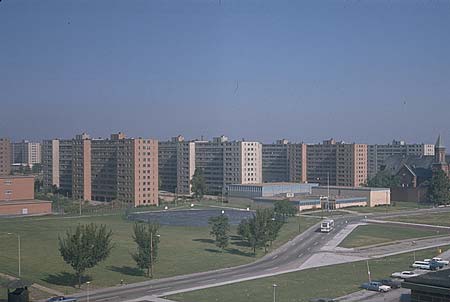
Pruitt Igoe, from wikimedia


This idea evolved some 40 years ago when American architect. Oscar Newman was witness to what happened at the newly constructed, 3,000-unit, public high-rise housing development at Pruitt Igoe. This was an infamous public housing scheme that was said to be an example of everything that was wrong with modern architecture.
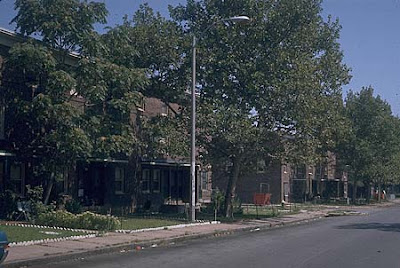

Carr Village Square, from Wikimedia


However, across the street from Pruitt-Igoe was an older, smaller, row-house complex occupied by an identical population, Carr Square Village. It remained fully occupied and trouble-free throughout the construction, occupancy, and decline of Pruitt-Igoe. With the social variables constant in the two developments, what, Newman asked himself, was the significance of the physical differences that had enabled one to survive while the other fell apart?
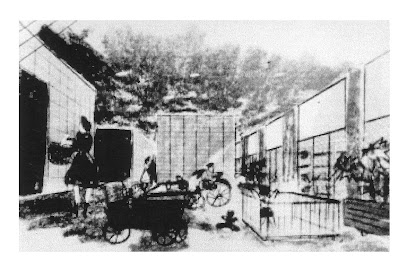
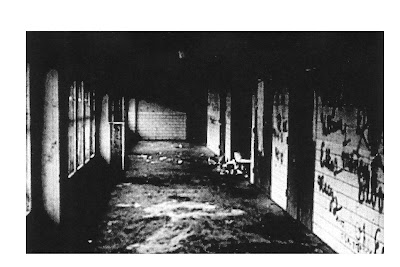
Pruitt Igoe - architectural illustrations versus actual photos

At the Pruitt Igoe project, Newman found the residents to be decent people, no different from the residents at the low-rise development next door. But whereas the Carr Square Village development had access staircases and small landings shared between a few neighbours on each floor, the Pruitt Igoe flats had long corridors shared by large numbers of units. There were units on the ground floor at Carr: ground floor residents looked out onto the street. At Pruitt Igoe, the ground floors were mainly open “recreational” spaces - placed away from the street - that quickly became “no man’s” land.

Newman believed that that design should propagate “natural surveillance” generating opportunities for people to see and be seen continuously. Knowing that they are, or could be, watched makes residents feel less anxious, leads them to use an area more and deters criminals by making them fear being identified and caught. In Pruitt Igoe the corridors were “blind” corridors – without windows overlooking the passageway, there was no possibility of surveillance.

But people must not only watch: they must also be willing to intervene or report crime when it occurs. Newman proposed reducing anonymity and increasing territorial feelings by dividing larger spaces into zones of influence. This can be accomplished on a small scale by clustering a few apartments around a common entrance or a common elevator. This was the situation in the low-rise development at Carr Square Village.
On a larger scale individual yards or areas can be demarcated by having paths and recreational areas focus around a small set of apartment units or by having each building entry serve only a limited number of apartments.

Newman considered man as a territorial being, as a being that needs territory like he needs water, in order to be able to live a satisfactory life. He believed that man is not basically criminal – preferring social cohesiveness to anarchy, social harmony to tension. Providing surveillance over defensible spaces allows man to be in his natural state, surveying and defending his domain.

Newman and his followers tested these ideas by studying housing developments in cities across the country, from New York to San Francisco, and concluded that rates of crime, vandalism and turnover were lower in places that conformed to the principles of defensible space. In a variety of large and small cities, housing projects and urban neighbourhoods have been redesigned in accord with defensible space principles. While the results have not been consistent, reductions in crime and fear and increases in a sense of community have been found in several places. The concept of Defensible Space enabled residents to take back control of their neighbourhoods and reduce crime.

As for the Pruitt Igoe project - it was demolished by controlled explosion. Minoru Yamasaki would later design the World Trade Center. This was one very unlucky architect.


Pritt Igoe demolished

References: Charles Mercer, “Living in Cities”, 1974
Oscar Newman, “Defensible space”, 1972


Related Post:


Enter your Email


Preview | Powered by FeedBlitz

Subscribe in a reader


Social Bookmarking

Add to: Digg Add to: Del.icio.us Add to: Reddit Add to: StumbleUpon Add to: Yahoo Add to: Google Add to: Technorati Information

Wednesday, October 17, 2007

The Children-Friendly City of Delft

Delft , a small city of about 100,000 people in the Netherlands, pioneered the concept of the child-friendly street called from way back in the 60’s.

The idea of the child-friendly street can be traced back to Colin Buchanan and his report in 1963 for the British Government - “Traffic in Towns”. Buchanan, a road engineer as well as an architect, saw the conflict between providing for easy traffic flow and the destruction of the residential and architectural fabric of the street. For the first time, road design was seen as not just to serve cars but people as well, and that included children.

The ideas in the report were not initially well received in Britain but in Holland, these theoretical concepts inspired Niek De Boer, professor of urban planning at Delft University of Technology. He saw in Buchanan's concepts a possible solution to overcoming the contradiction between streets as places for children's play as well as car use. De Boer designed streets so that motorists would feel as if they were driving in a "garden" setting, forcing drivers to consider other road users. He invented the term ”woonerf” which roughly means “residential yard" in Dutch.

People Power


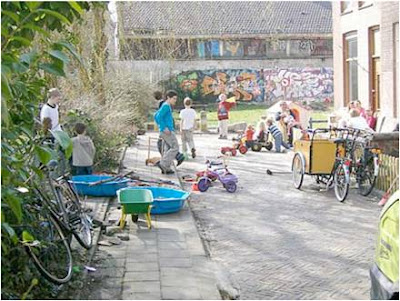
At the same time in the same city, residents of an alley in the city centre converted a derelict plot into a play area, with a little help of the municipality and a paint factory. Walls were painted, huts were built for hiding and climbing and trees and shrubs were planted.


Hopstraat, Delft

In another area – in a densely-built district with small houses - a group of residents squatted one of the streets. They claimed it for playing, planting and sitting. The municipality decided to allow this change to happen, recognizing that there was a lack of play area in these working class areas.


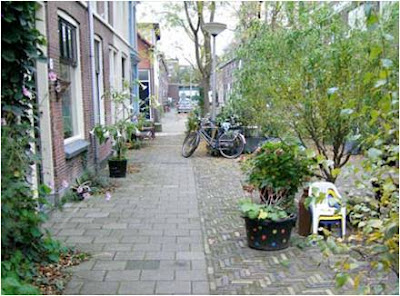
Tuinstraat, Delft

This started a process of redefining and redesigning streets that can be described as: ‘streets for children, where cars are allowed, but only within limitations’. Theory and practice merged, with new regulations new types of streets where:
  • car speeds were reduced

  • pedestrians had right of way to the whole width of the road

  • space was created for trees where there was only tarmac

  • residents were given a small semi-private zone in front of their houses with greenery and benches


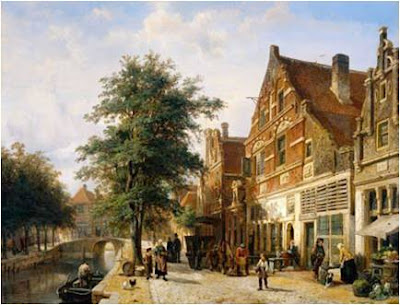
This new type of street could relate back to the historic ‘streetscape’ of the canals streets in Holland as inspiration.


Zuiderhavendijk Enkhuizen ( Cornelis Springer, 1886 Rijksmuseum, Amsterdam

Stehen Schepel wrote in "Woonerf Revisited":
“The narrow streets alongside the canals performed many functions. Goods were unloaded and traded or loaded again after temporary storage. The ‘stoep’ or sidewalk running in front of the house was used for display and trade, but also for sitting outside and meeting other people. The middle of the street was primarily for pedestrians, but also used by horses with a cart or a sledge. Busy street life brought about a lot of experience for the young. Trees made for an agreeable environment.”


The concept of ‘woonerf’ rather quickly found acceptance by the Dutch government. Special rules for traffic on a ‘woonerf’ were issued. The idea of ‘woonerf’ was adopted by many local authorities and spread to many other countries.

The experience in Delft, shows how cities can be children-friendly by making the streets in front of their homes safer. Linking these streets together has resulted in a whole neighbourhood that is accessible for children to enjoy.

Again from Steven Schepel:
Safety

“Low speed minimizes the risk of serious accidents. It leaves road-users more time to avoid a collision and shortens the distance covered, first during the time that it takes to react and then during the process of slowing down."

"If a collision cannot be avoided after all, the blow will be less severe and the injuries will be less serious. But nearly always in incidents at low speed everyone will escape with a fright."


"Security for children depends largely on the presence of adults, not just pedestrians and other non-motorized road users, but also people watching the street out of living rooms and kitchens."

"The interaction with adults (for imitation, confirmation, or out of just curiosity) makes the street extra attractive for children to play in and is a good opportunity for adults to meet one another casually.”

Independent movement

“Independent mobility enables children to participate in all sorts of activities without burdening the parents to fetch them each time. Finding their way they get better acquainted with the outside world and develop their social skills. Independent mobility starts with freedom of movement in the street.Prerequisites are low speed (allowing time to make eye-contact and assess mutual behaviour)and limited amounts of car and cycle traffic."

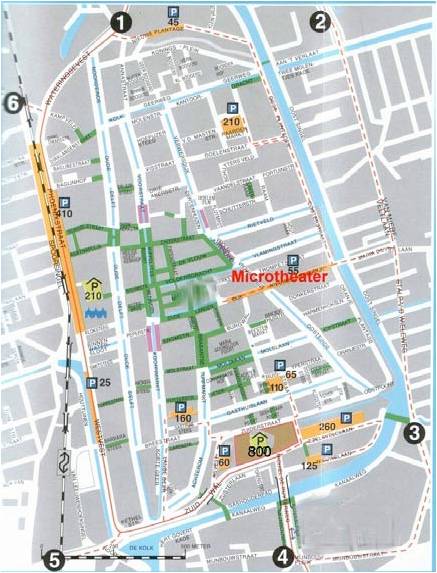
"Independent mobility must not be confined to freedom of movement in a single street. So the street should be part of a large, wide child friendly habitat. Delft serves as an example, showing that a comprehensive rearrangement of a large district, like the complete city-centre, is feasible. This area, which is 1500 m long and 1000 m wide, is not cut by any major road. However buses and cyclists can cross the town in all directions."


City-centre, Delft

"Moreover child friendly districts should be interconnected by safe, friendly routes for cyclists and pedestrians, for children and elderly alike. Again, Delft serves as an example by having completed a tightly knit, comprehensive network of routes for cyclists and pedestrians all over the town.”


Enjoying life in the city

“In order to foster experience and enjoyment, a child-friendly street can best be conceived as a sequence of outdoor living-rooms, each with its own character.”


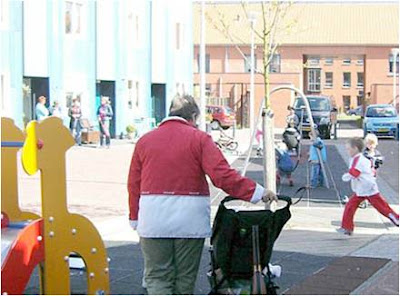
Playgrounds on the street: they show everybody that this is a street for living.


Rotterdamseweg, Delft

The people of Delft believe that:
"a city that is friendly to children is a city friendly to all!"


References: “WOONERF REVISITED - Delft as an example” by Steven Schepel, Childstreet Conference. Delft, 2005: 2 Mb pdf Download
Streets for People Too, Architectureweek

Related Post:


Enter your Email


Preview | Powered by FeedBlitz

Subscribe in a reader


Social Bookmarking
Add to: Digg Add to: Del.icio.us Add to: Reddit Add to: StumbleUpon Add to: Yahoo Add to: Google Add to: Technorati Information

Tuesday, October 9, 2007

Childhood in the City

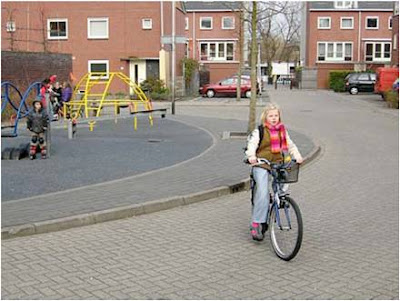
My 8 year old daughter asked if I could go with her outside so she could ride her new bike. I said she could go out by herself. “Mommy won't let me!” she whined. With the abduction and murder of Nurin just a few weeks ago, I didn't argue with my wife. But I wanted to!

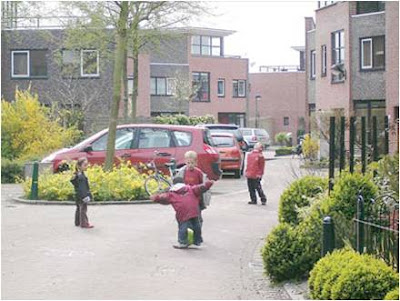
We live in a cul-de-sac in a Kampung Melayu Ampang, free from fast moving traffic, with a playground just outside, and relatively free of outsiders. If it's not safe for my daughter to play outside by herself here, there is not many places in and around Kuala Lumpur that is safe.

Pity the children living in towns today. It's proper that parents want to protect their children from the traffic risk and stranger danger, but in doing so are our children are missing out an essential part of childhood? This was the point an open letter to the Daily Telegraph signed by 110 teachers, psychologists, children's authors and other experts call on the (British) Government to act to prevent “the death of childhood” due to , among other things, over-anxious and over-protective parents.

Is the golden childhood of our memories and Lat's cartoons forever gone? Do we have to accept that the modern city is just not a suitable place for children?


Girls playing


Boys playing

But perhaps our memories are too selective – we who survive only remember the good things. Despite the publicised cases of abductions and accidents, overall, hard statistics will surely tell us that mortality rate of children have reduced a great deal from 30-40 years ago. Children also experienced more poverty and fewer opportunities.

Turning back time is not an option, and neither is mass migration back to the country. Modern urban life is here to stay: most of the developed world is more than 80% urbanized and developing countries are fast catching up.

But we can choose to be rational rather than be driven by fear. There are policing and management measures that can be undertaken to make our towns and cities safer. There are the examples of cities with low crime rates (like Japanese ones) that we can learn from. There are examples also of cities almost on the brink of anarchy that have pulled back and lowered crime rates (New York).

Architects and planners have been working on housing designs and town layouts that can minimize the dangers from traffic and crime, and thus at the same time providing safe places to play just outside the home. An American, Oscar Newman, introduced the concept of Defensible Space over thirty years ago as a strategy to reduce crime, and at about the same time, Dutchman Niek De Boer pioneered Living Streets or “woonerf” that were designed to tame motor vehicles so that the streets became safe places for children to play in. They are the inspiration for the designs you find in this website.

Cul-de-sac court yard


Apartment Lobby


Communal Courtyard

Related Post:


Enter your Email


Preview | Powered by FeedBlitz

Subscribe in a reader


Social Bookmarking