Showing posts with label Middle East. Show all posts

Saturday, September 15, 2007

The City of Babylon


Source: www.alexanderstomb.com

Herodotus has a description of the famed Babylon,

"The city of Babylon is situated on a large plain. It is square in shape, and each side is fourteen miles long, so that the complete circuit is fifty-six miles. It is built like no other city known to the Greeks. A wide deep moat full of water runs round it, and inside the moat is a wall 330 feet high and 86 feet thick."

Walls, Moat and the making of Bricks


Source: http://proteus.brown.edu

"I must tell you where the earth was used when it was taken from the moat, and how the wall was built. As they were digging the moat they formed the mud which was brought out of the excavations into bricks, and when they had molded a sufficient number of bricks, they baked them in kilns. With these bricks they built the banks of the moat, and after that the wall itself, using hot bitumen for mortar and inserting reed-mats every thirty rows to strengthen it. Along the edges on top of the wall they put one-roomed buildings facing each other, with sufficient space between them for a four-horse chariot to turn round. There are a hundred gates in the wall, all made of bronze with posts and lintels of the same material."

The City Grid

"The city itself contains many houses three or four stories high, and all the streets are straight, some running parallel to the river and some at right angles to it. At the end of each street which runs down to the river there is a gate made of bronze in the wall to give access to the river. These walls form the city’s outer defense. Inside them there is another wall, narrower than the first but almost as strong."

The Euphrates

Source: http://proteus.brown.edu

"The Euphrates, a wide, swift and deep river which rises in Armenia and flows into the Persian Gulf, runs through the city, dividing it into two parts. The wall runs down to the river on either side, and the ends are joined by fortifications of baked bricks along each bank of the river."

The Tower of ‘Bel’

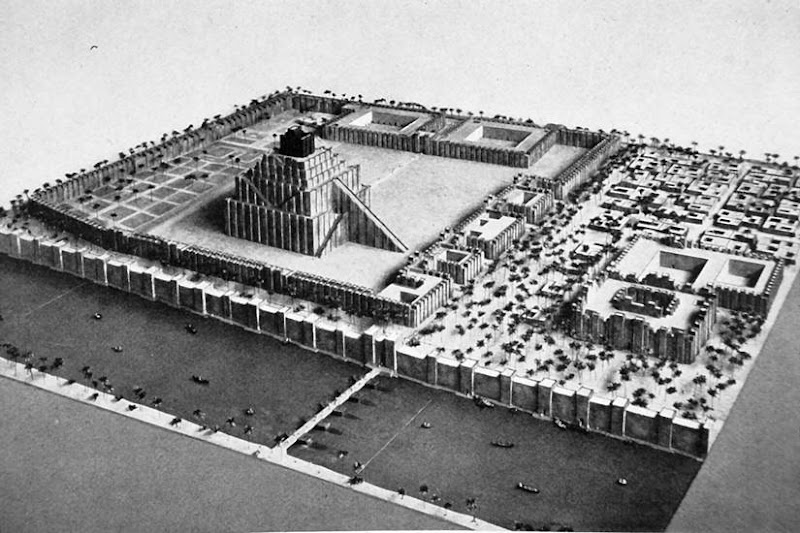
"In each half of the city there is a fortified building; on one side of the river there is the royal palace with its great defensive wall, and on the other is the temple of Bel, the Babylonian Zeus. This is an enclosure a quarter of a mile square, with bronze gates, and was still in existence when I visited Babylon."


Source: http://proteus.brown.edu

"In the middle of the enclosure is a solid square tower with its sides more than two hundred yards long. On top of it there is another tower, and another on top of that, and so on up to eight stages. The staircase to the upper stories runs spirally round the outside, and about halfway up there is a platform with seats where people going up can rest. On the top story there is a large temple in which there is a great couch covered with fine draperies, with a table made of gold alongside it."


Source: www.ancientworlds.net

Reference: Herodotus 484 - 425 BC, "Histories"


Related Post:


Enter your Email


Preview | Powered by FeedBlitz

Subscribe in a reader


Social Bookmarking
Add to: Digg Add to: Del.icio.us Add to: Reddit Add to: StumbleUpon Add to: Yahoo Add to: Google Add to: Technorati Information

Wednesday, September 12, 2007

High-Rise Mud Houses of Yemen

There is a Yemeni proverb:
"However tall the mountains are, that is how tall the houses will be."


Source: www.viaggiaresempre.it

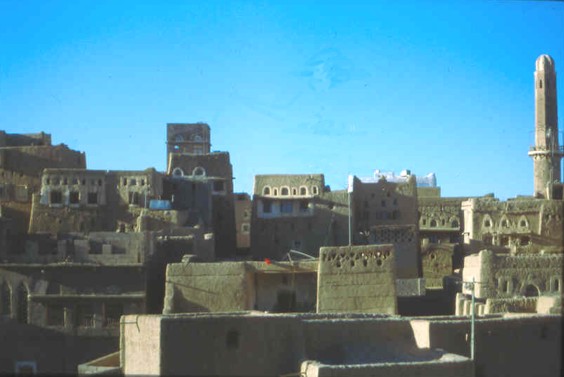
Indeed Yemen is famous for its high rise towers. Here the height of their homes was an indication of the owner's wealth and power. Land there is also scarce and expensive. Besides the towers served a defensive purpose in troubled times. Each houses a family. In this typical example, the ground floor is for the animals and storage; the first floor for the living rooms and bedrooms; above that would be the kitchen. The top floor contains a the mafrai: This is the large room where the owner of the house meets his friends, and it is usually the only decorated room in the house. At night the man of the house invites friends to come to his mafrai and chew qat leaves, which contain mild stimulants.


Construction workers dig deep into the ground to find firm soil and, at the bottom of the trench, place a layer of animal droppings covered by a layer of salt. On this course they place timbers parallel to the walls, with stones packed in the interstices. In this manner, the builders construct a masonry wall of stone and lime up to street level. Then they pile sun-dried mud bricks up to the sixth floor, reducing the thickness of the walls as the building rises so that the internal dimensions seem to be constant and the external profile tapers slightly from ground to roof.The houses are topped by flat roofs surrounded by parapets to form terraces. These terraces are waterproofed with an application of ramad - a plaster of lime, wood ashes and sand.


It usually takes between half a year to 5 years to build a house. Some houses have been under construction for decades. People have moved in already, yet the construction is still proceeding.


Source: www.viaggiaresempre.it
Reference: By Chen Chih-hung and translated by Teresa Chang


Related Posts:


Enter your Email


Preview | Powered by FeedBlitz

Subscribe in a reader


Social Bookmarking


Add to: Digg Add to: Del.icio.us Add to: Reddit Add to: StumbleUpon Add to: Yahoo Add to: Google Add to: Technorati Information

Tuesday, September 11, 2007

Mudhouses in Yemen


"Traditional houses in Yemen can described by the geographic features from which the indigenous materials are taken. In the coastal plain, reed, mud, and coral stone are used. In the mountainous regions, stone is the most predominant building material. In the high plateau areas, both local mud and stone form a hybrid of construction materials."


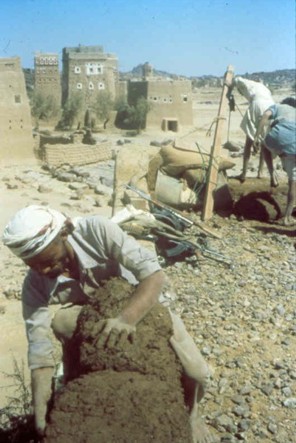
"The builder knows exactly how to mix the right combination of mud and straw. These are combined on a pile on the ground, water is added and the men start to mix with their feet. The builder then takes the mixed mud and adds it to the top of the wall. After 2 feet or so are added to the wall, the wall is left to dry... perhaps several weeks or months. When it is rock hard, the builders will return and add another layer. When they want to create a roof or floor, logs are placed across the space, smaller sticks are placed the other direction and straw is woven to create a giant mat. Then mud is added to the floor, and the builders start working their way up another story."


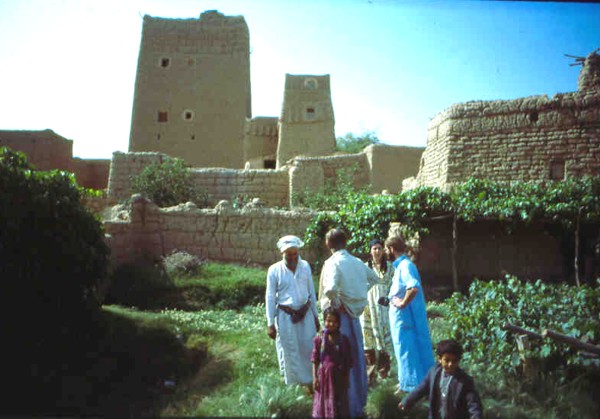
"The tall tower in the background is for the men of the family. The lower buildings are occupied by the wives, and livestock.

In the garden, the vines are planted in trenches six to eight feet below the surface of the ground. The vines then grow up and spread themselves at ground level. In the hot summer months, the Yemeni like to go down into the trenches and relax in the cool air until the hot summer sun disappears.

It is possible to see the various layers in the houses. The buildings all lean inward to give added strength to the building. Many of these buildings survive for hundreds of years. However, they need patching if there is a long rainstorm."


Sources:
Richard Brooks Jeffery
The Incense Road


Related Posts:


Enter your Email


Preview | Powered by FeedBlitz

Subscribe in a reader


Social Bookmarking
Add to: Digg Add to: Del.icio.us Add to: Reddit Add to: StumbleUpon Add to: Yahoo Add to: Google Add to: Technorati Information