Showing posts with label Malay Civilization. Show all posts

Friday, October 28, 2011

From Pekanbaru to Siak Seri Inderapura and the past Sultanate of Siak


The boat passed under an attractive slender bridge. Here a modern highway crossed over a much, much older one. Early Malay civilization was based along coastlines and navigable rivers, but I had never experienced this in a personal way until today. I'm on a 90 km river trip down the Siak River in the Riau Province of Sumatra, from Pekanbaru (literal translation: “new town”) to Siak Sri Inderapura, once the seat of the Siak Sultanate.


Roads in Sumatra are notoriously bad. The boat I was on sped by a regular succession of not only wooden jetties, outhouses, and houses on stilts, but also concrete docks with gantries, silos, gas tanks, containers and tall piles of timber. There are occasional signs of decay - abandoned warehouses, rusty cranes on decrepit timber docks. It is said that cheap air travel has largely killed the passenger traffic between peninsula Malaysia, Singapore and Pekanbaru. But for now at least, this old river route still has life in it.

The landscape is familiar -mangrove and thick jungle line the banks, rubber and oil palm, just behind. The country here flat; just outside Pekanbaru it was undulating but since then I hardly seen a hill. There are also timber plantations. In a few places, I saw tall closely planted trees in rows of varying maturity and heights. I found out later at Universitas Lancang Kuning back in Pekanbaru. that they were gum trees - aparently, a local specie of the eucalyptus.


Two hours from Pekanbaru, we reached Siak Sri Inderapura, the centre of the old Siak Sultanate which started at the turn of the 18th Century with the murder of Sultan Mahmud Shah II of Johor (a descendant of the Melaka Sultans). His wife, Encik Pong, ran away to Singapore, then Jambi, and whilst on the run, gave birth to Raja Kecik, later to become Sultan Abdul Jalil Rahmat Syah.


Raja Kecik did try to reclaim the Johor throne but without success. He then retired to the Buantan region of the Siak river. Thus a new kingdom was established with Senapelan (now Pekanbaru), Kota Tinggi, Mempura Kecil and Siak Seri Inderapura being some of settlements in it.

It was the 11th Sultan, Syarif Hasyim, who built the palace in Siak Sri Inderapura, which stands just a short distance away from the town jetty where I disembarked.


Designed by a German architect in a style that blended Indian, Arab and European influences, it may be grand but not big. It has one big hall in the middle - a sort of throne room - and smaller galleries on all sides. In the front was a reception hall and to one side was the dining. Two ornamental spiral staircases are placed in the room just behind the throne room. Upstairs were four rooms for guests. The Sultan and his family stayed in a modest bungalow next to the main palace.

Nearby, is the Sultan's mosque; next to it, the tomb of Sultan Syarif Qasyim, the 12th Sultan of Siak. He was an ardent supporter of Soekarno and declared his Kingdom to be a part of the Republic of Indonesia. He did not have any children. He died in 1968 leaving two wives, but no heir to the throne.


In 1997, the Republic declared the last Sultan of Siak as a National Warrior.

Friday, March 21, 2008

Rumoh Aceh

I'm not sure that Acehnese culture can be categorized as "Malay", but there is a section on Aceh in this interesting website: melayuonline.

Malaysia tend to think of the Malaysian peninsula, also called Malaya,as the home of the Malays. Yet it is clear that Malay culture has its roots in the Sri Vijayan culture based in Sumatra in Indonesia. The legacy of that culture is still strong in Indonesia; after all the Indonesian national language is Malay even though ethnic Malays form a very small minority in that country. And melayuonline is based in Indonesia not Malaysia.

This is a replica of the house of Acehnese heroine Cut Nyak Dhien, from the Aceh War. The House was burnt down by the colonial forces but a replica and is now a museum at Lampisang, about six kilometers from Banda Aceh, .


From foodeureka.com

These are examples of more humble traditional Aceh house:


From abuafatah.blogspot.com


Many of these houses were destroyed by the Tsunami of the 26th November, 2004, but this one survived:


From Reconstruction after the Tsunami

There are many similarities between traditional houses in Malaya and Aceh, but the stilts are much more stout in Aceh. The construction has taken account that Aceh, unlike Peninsula Malaysia, is a country of earthquakes and volcanoes.

Further reading: Reconstruction after the Tsunami (pdf download 500kb), and

Tuesday, March 4, 2008

Rumah Gadang

Rumah Gadang in the Minangkabau Malay dialect means 'big house'. Some of the Minangkabau people of the central highlands of Sumatra live in Rumah Gadang, with several generations living together in these large communal homes. They follow a matrilineal tradition, unique in Indonesia, where ownership of the homes are passed on to female heirs.

Rumah Gadang (1910)


It is said that the Rumah Gadang originated from Tantejo Gurhano from Pariangan, Batusangkar.

Sitinjau Laut


Usually, the Rumah Gadang has three small buildings or 'rangkiang' in front of it, used to store rice:
  1. Sitinjau Laut
  2. Sibayan-Bayan
  3. Sitangka Lapa


The Rumah Gadang has three main areas: immediately after the entrance comes a middle ares (Rumah Tongah), where there is normally a central post; adjoining this the Anjuang, and the bedrooms (Biliak). Opposite the Anjuang is the kitchen and in front of that a large space (Pangkalan), where visitors are received.

The house is largely constructed of wood; an exception being the being the rear longitudinal wall which is a plain lattice woven in a chequered pattern from split bamboo. The roof is of a truss and cross-beam construction, and is typically covered with thatch from the fibre of the sugar palm (ijuk), the toughest thatch material available and said to last a hundred years. The thatch is laid in bundles which can be easily fitted to the curved, multi-gabled roof.

Buffalo horns shape - Rumah Gadang's roof


Roof finials are formed from thatch bound by decorative metal bindings and drawn into points said to resemble buffalo horns - in fact,'Minangkabau' is thought to be derived from 'menang kerbau' or 'win buffalo'.

The roof peaks themselves are built up out of many small battens and rafters.

The External carvings of a Rumah Gadang

Today, Minangkabau people rarely live in Rumah Gadang as they tend to build modern houses. But, there are still some Rumah Gadang preserved by the local government.

Sources:-
- wikipedia.com
- indonesia-tourism.com
- ambig.fotopages.com
- tradiotional houses of Indonesia

Friday, December 28, 2007

The Early Malays

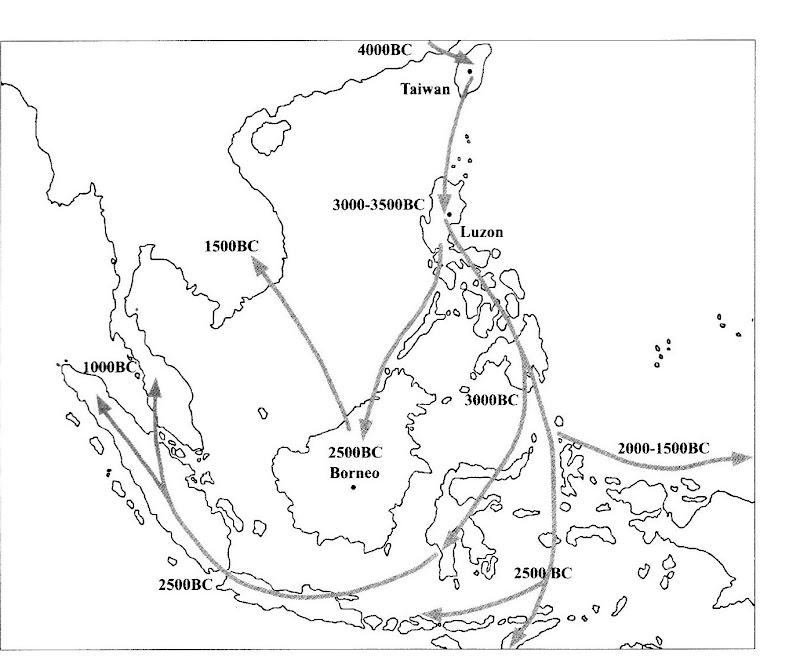
The Malays that colonized what is now the Malaysian peninsula at about 1000BC were a sea-faring people. They are a branch of the Austronesian peoples that can be traced back to Southern China who migrated downstream the Chang Jiang (the Yangtze River), and learning how to build their dug-out canoes along the way. They developed sea-faring techniques to move to Taiwan, Phillipines , Borneo and then to Malaysia and elsewhere.


Austronesian migrations

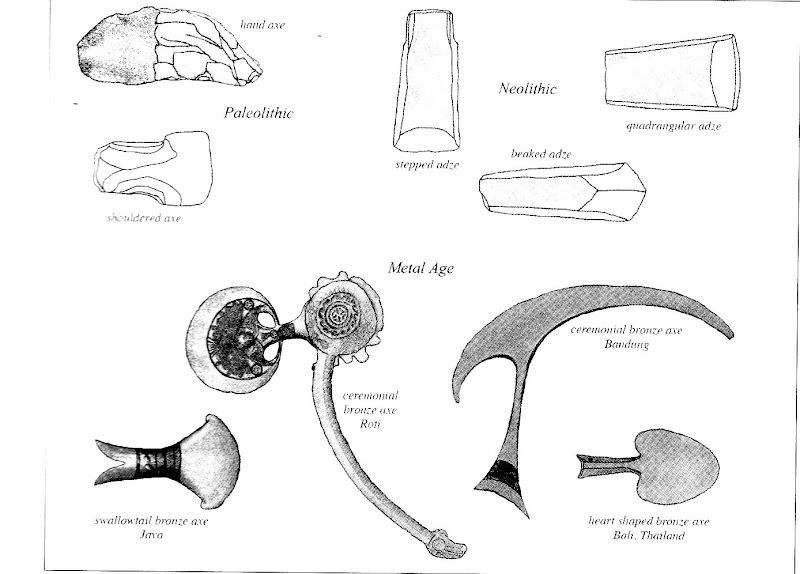
Before the iron age, cutting down the thick jungle would have been an immensely hard task; the humid forest was also very difficult to burn. So they would have worked together in multi-family groups, and travelling up from the river estruaries, would have kept close to the river banks. The jungle and the river provided enough for their sustenance; ‘slash- and-burn’ shifting agriculture had to wait for the ‘parang’ or machete. The technology came from either Central Thailand or North Vietnam, probably by way of Austronesian cousins who settled in South Thailand since 1500BC.


Evolution of the axe and adze

Rice planting came with the introduction of more sophisticated metallic implements from the North, starting from about 300BC in Indonesia.

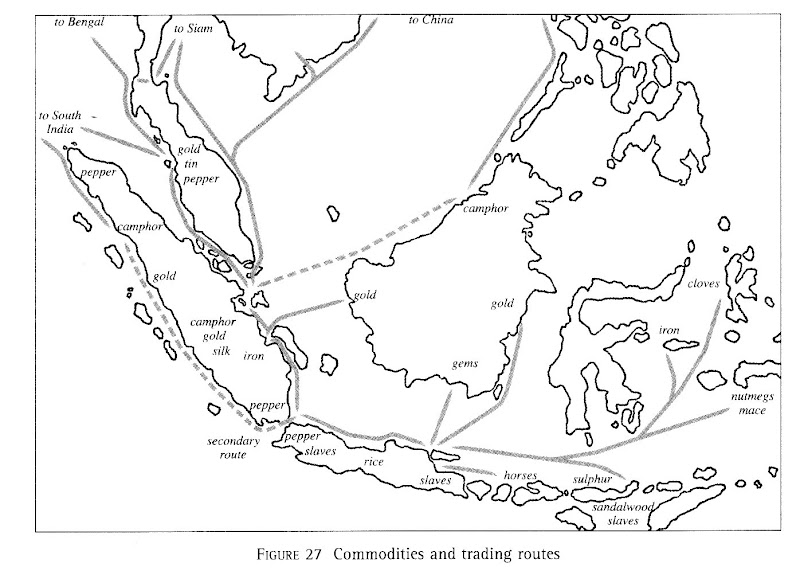
But the pre-eminent occupation for the early Malays was trade. And the Malay peninsula was located in a strategic position between China and the Spice Islands to the east and India, the Arab lands and Europe to the East. Regular trade contact with India started in the 1st millennium BC; Chinese records of South East Asian ports start from the 1st century AD. The naval Spice Route at that time competed successfully with the Silk Road.


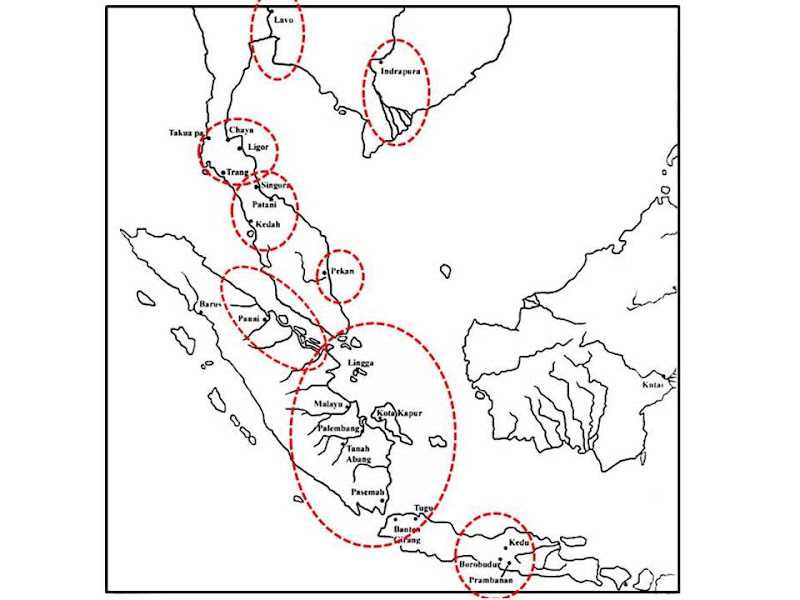
But the source of the earliest Malay civilization did not spring from the peninsula but rather from across the Straits, from the island of Sumatra around the start of the 1st century AD. Palembang and Jambi were two settlements that came together and became the basis of Srivijaya. This was for most of the time a loose confederation of ‘kedatuans’, political entities based in the port-towns, that in addition to Palembang and Jambi in Sumatra, included outposts in Kedah and Langkasuka in the Malay peninsula, Kedu and Borodubor in Java, and Inderapura in present-day Cambodia.


Maximum extent of Srivijayan influence

Srivijaya was a maritime civilization, and its ports received traders from China, India and other parts of the world. The Indian connection was especially strong: Hindu and Buddist beliefs played a major role in the early Malay world. The oldest evidence of the Malay language comes to us in stone inscriptions written using an ancient Indian script. It is a mishmash of Sanskrit and quaint, but recognizable Malay.


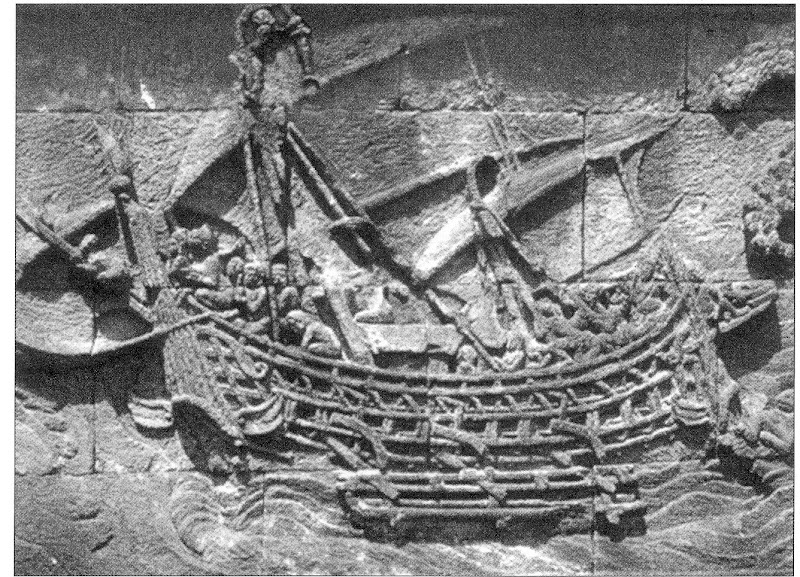
Carving of Srivijayan vessel at Borodubor

References and Source of Images

Paul Michel Munoz, "Early Kingdoms of the Indonesian Archipelago and the Malay Peninsula”, 2006

Related Posts:

Subscribe to Tessellar Blog
and get a FREE E-Book


HONEYCOMB HOUSING
An Affordable Alternative to Terrace Housing


17MB, 49 A4 pages, 57 illustrations


Technorati Tags:,,

Saturday, December 22, 2007

The Bujang Valley Archeological Museum

Another trip I made with my children was to a fast-growing town in the northern State of Kedah. Sungei Petani on first acquantance looks like a sprawling, prosperous but uninteresting town that has been benefitting from the spill-over of economic development in neighbouring Penang, about 30km south. The project that I am involved with as architect seeks to benefit from that growth.


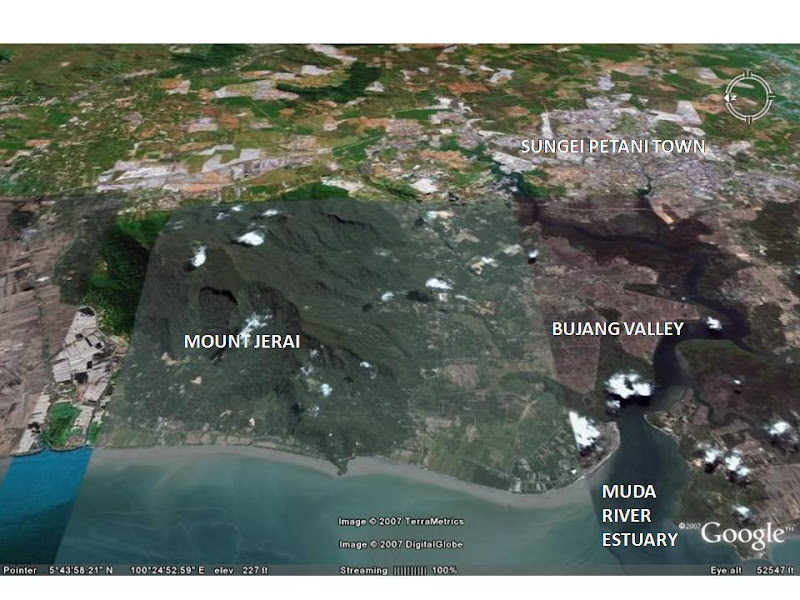
But in fact the town is more than just a would-be suburb of Penang. It is located near the Muda river estuary at the foot of Mount Jerai, which dominates the flat plain that surrounds it. Archeological finds in the Muda river and its tributaries has confirmed the area around Sungei Petani as the site of an ancient Malay port called Kadaram by the Indians and referred to as Ke-da by Chinese Annals.

When I was in school 40 years ago, we learned that the early Malays walked down from an area around South China (the area around present day Kunming) following from the proto-Malays. The first and greatest Malay civilization was in Melaka dating from the 14th Century BC. There has been considerable revision since then.

Kedah preceded Melaka by as much as 14 centuries. Several of the archeological finds have been collected, reconstructed and displayed at the Lembah Bujang Archeological Museum on the foothills of Mount Jerai.


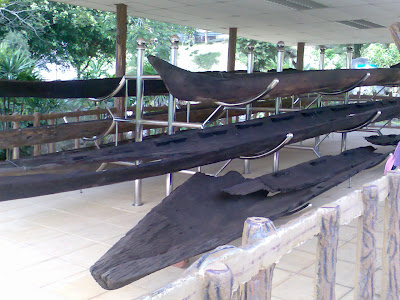
At the entrance of the indoor gallery are what look like dugout canoes, but are believed to have used sails as well. This is the core technology that brought the ancestors of the the Malays from South China to Malaysia by way of the Chang Jiang (the Yangtze River), Taiwan, Phillipines and Borneo. However, the dating of some of these timber boats from the first millenium AD (found on the museum notes) seems a bit incredulous to me!

That is the problem with archaeology in the hot and humid equatorial climate of South East Asia. Timber was the most convenient material for construction, but wood cannot withstand the effects of rot and insect attack. I’ve been told, though, that being submerged in water and in some way deprived of oxygen can preserve some hard-woods.


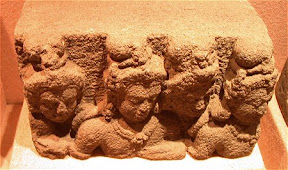
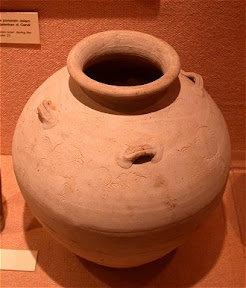
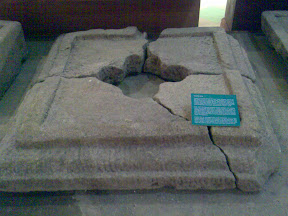
In the indoor gallery are plenty of beads of stones and glass, and ceramic pots that attest to Kedah as a trading port. There are also bits of shrines - some Hindu, some Bhuddist – stone statues, inscriptions in Indian script, granite column base, column sections, clay roof tiles and stone footings for long disintegrated timber posts.


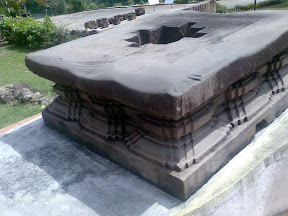
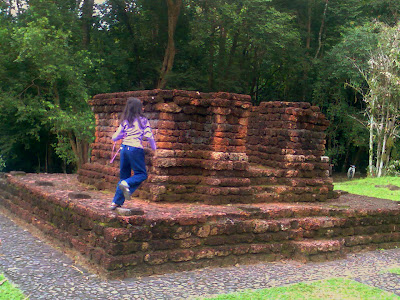
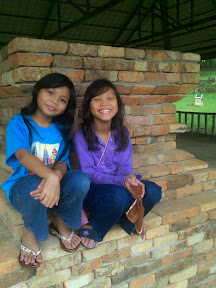
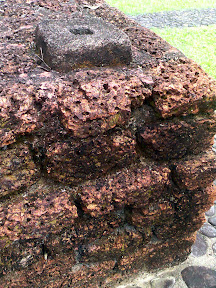
There is an external gallery where the base of some of the ancient shrines have been reconstructed. Some of these were made with granite and local stone, blending in with the stone boulders and outcrops of Mount Jerai. But others used laterite blocks, a softer and courser material.


One shrine used clay bricks with detailed corbels and recesses. These were believed to have been imported.


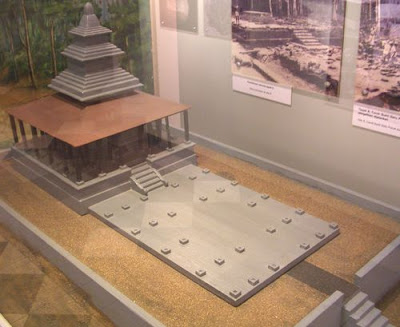
Only the base have been rebuilt, not the columns and the roof. But the stone footings for the timber columns have been put in place and you can just about imagine how these shrines could have looked like.


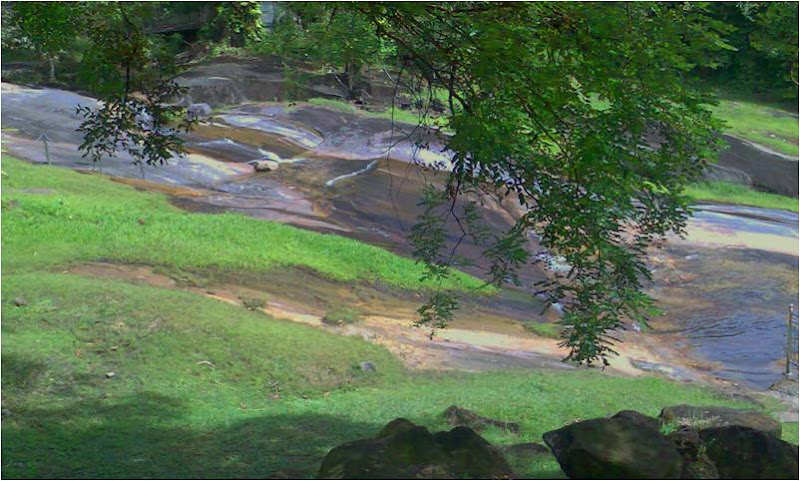
Right next to the museum grounds is a stream that rushes down a stretch of bare stone outcrop. This was where we rested our tired feet. If we had time and energy we could have continued up a trek to the peak of Mount Jerai , but that had to wait until my girls grow up a bit more.


For hotels and other things to do in Kedah, refer to Kedah Hotels

References

George Coedes, "Sriwijaya: History, religion & language of an early Malay polity : collected studies", Monograph of the Malaysian Branch, Royal Asiatic Society.

Related Posts:

Subscribe to Tessellar Blog
and get a FREE E-Book


HONEYCOMB HOUSING
An Affordable Alternative to Terrace Housing


17MB, 49 A4 pages, 57 illustrations


Technorati Tags:,, ,