Showing posts with label Circular Cities. Show all posts

Monday, August 4, 2008

Circular and Hexagonal Farms

I found this spectacular view of irrigated farms in Libya from deputydog


"Center pivot irrigation is basically a method of agricultural irrigation which results in a circular field of crops. a huge column of sprinklers, fixed to the ground at one end, slowly travels around in a circle whilst spraying the crops below. you can see the sprinkler arms, some of which can reach a kilometre in length".

The hexagonal forms look like they are made up of clusters of houses in the middle and farmland radiating out.


View Larger Map

Wednesday, February 20, 2008

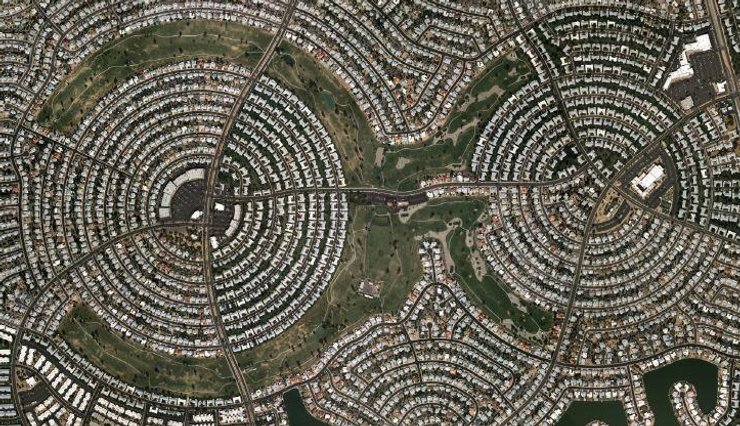
Circular Communities


I was surprised by a HUGE spike in visitors the last two days. It was thanks to the blog "Deputy Dog" , which did a fantastic post on circular communities viewed from the air. It cited my Round vs Rectangular Houses post I wrote earlier this year.

So thanks Deputy Dog!

Tuesday, January 8, 2008

Round vs Rectangular Houses

I am myself surprised that there are so many examples of round traditional houses. Round houses will continue to provide a lot of material for this blog. Yet there are few modern examples of circular houses: Buck Fuller’s Dymaxion is a case in point: it is marvel of fantastic ideas, all in one house, but one of its failures is that it just half-tackles the issue fitting in more rooms; and then, it doesn’t try to answer at all how these houses assemble together to form neighbourhoods, towns and cities.
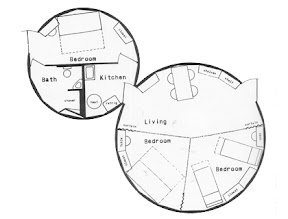

Twin Dymaxion


This is the great advantage of rectangular houses and rectilinear grids: rectangular houses are easily partitioned into smaller rectangular rooms; the house can grow by attaching new rectangular rooms to the existing structures; two rectangular houses can be built next to each other in a regular arrangement. This is the theory as to why the pre-agricultural Natufian civilization, which probably built the world's first houses, moved from circular to rectangular houses.

Urbanization, having high numbers of people living next to each other, meant individuals had to accept greater limits to their freedoms.

When an authoritarian power could decide that a town would have a regular layout, the orderly form of the rectilinear grid proved itself not only amenable to central planning , it was also convenient to the individual householders. This was something they could live with.

In the Harappan civilization of the Indus Valley, the cities were not all laid out in a perfect orthogonal layout. They were not all centrally planned; they have been described as semi-grids. Semi-grids perhaps evolved as a matter of a convenience, where a series of rectangular houses are added on, one by one, along a path. Perhaps Mohenjo Daro’s grid was not imposed by a dictator!
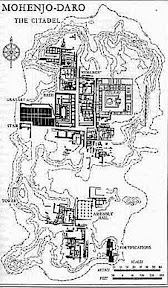

Mohenjo Daro


There have been rulers who imagined and then built for themselves round cities. The structure at the centre of the circle is given prominence. But the houses themselves are not round. In the Round City of Baghdad they were rows of buildings that form a circumference of the circle. Such buildings are inflexible - not easy to plan and build. In Circleville in Ohio, US, the citizens found the shape a nuisance and increasingly ignored it as the town grew.
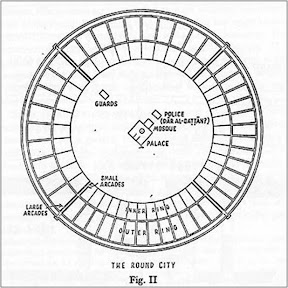

Round City of Baghdad


In Denmark near Copenhagen is an interesting example of a circular neighbourhood. No round houses here, and furthermore, the neighbourhoods don’t relate to each other in a circular geometry. Not much of an improvement from the Yanomamo.
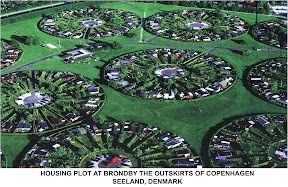

Brondby, Copenhagen
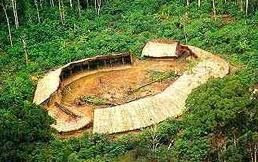


The Round Yanomamo Communal House


Round houses in a round neighbourhood in a round city in a round planet. This fanciful idea does not work!

But happily, being impractical does not make them less interesting...

Subscribe to Tessellar Blog
and get a FREE E-Book


HONEYCOMB HOUSING
An Affordable Alternative to Terrace Housing


17MB, 49 A4 pages, 57 illustrations

Technorati Tags:,,

Thursday, December 20, 2007

Eid ul- Adha

Today we celebrated Hari Raya Haji in Malaysia, a religious festival celebrated by Muslims all over the world, and better known as Eid ul-Adha. On this day, Prophet Abraham proved his love and devotion to Allah by showing his willingness to kill his beloved son if Allah wished it. In the end Abraham did not have to kill his son as Allah gave him a ram to sacrifice instead.

Eid ul-Adha also coincides with the Haj, a pilgrimage to the Muslim Holy Lands that is compulsory for every Muslim that is able to afford it.


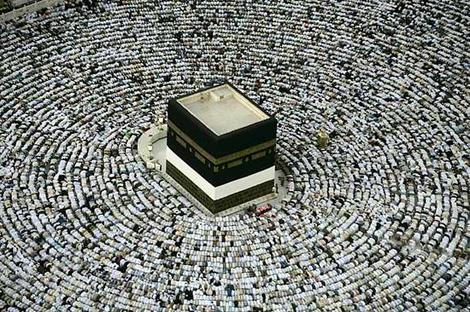
Muslims face the Kaaba when they pray

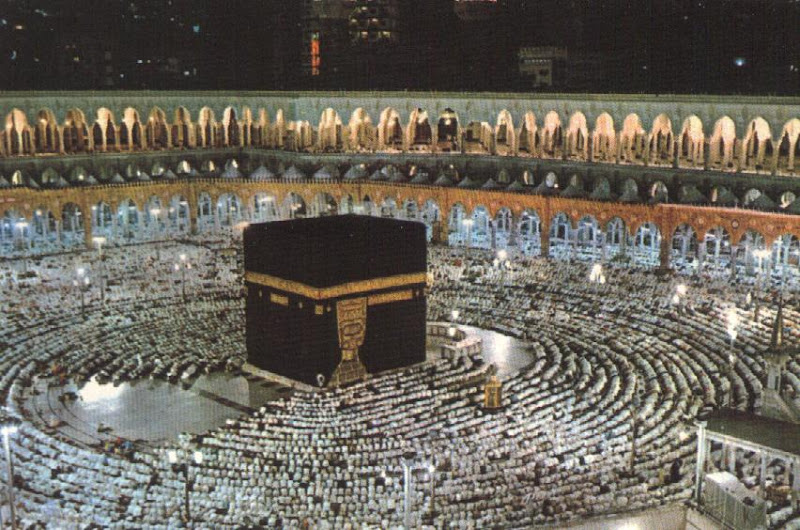
The Haj starts at Mecca on th 8th day of Dzul Hijjah the 12th month in the Muslim calender. They perform their first Tawaf, which involves all of the pilgrims entering The Sacred Mosque Masjid al Haram, and walking seven times in a counter-clockwise direction around the Kaaba.


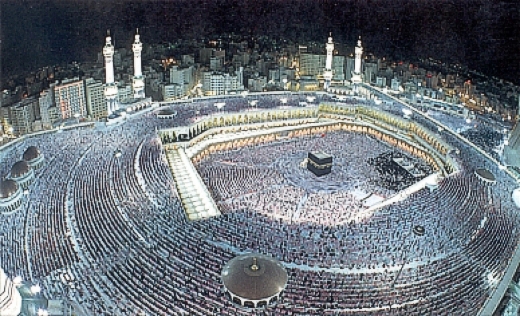
Mosques are usually rectangular structures, and so is the Masjid al Haram


After the first Tawaf, the pilgrims perform sa`i, running or walking seven times back and forth between the hills of Safa and Marwah. This is a re-enactment of Abraham's wife, Hajar, frantic search for water for her son, before the Zamzam Well was revealed to her by an angel sent by God.

As part of this ritual, the pilgrims also drink water from the Zamzam Well. The pilgrims then return to their encampment in Mina.

The next day pilgrims proceed to the plains of Arafat and stay out in the open contemplating Allah. A the end of the day, they travel to Muzdalifa for the night. There they gather small stones for the next day.

In the morning of the 10th day, they return to Mina and throw the stones at pillars which represent the devil. Then a sacrifice is made in which an animal is slaughtered and the meat distributed among the poor. After this, men's heads are shaved and women cut a lock of their hair. This is the day of Eid ul-Adha.

They next return to Mecca and make another Tawaf. Then it's back to Mina where pilgrims must again stone all three pillars in Mina for two or three days.

Finally they do the last Tawaf in Masjid-al Haram before leaving Mecca. Many continue to the Prophet's Mosque in Medina where the tomb of Prophet Muhammad is located, but this is not obligatory.


The architecture of flesh and blood against that built in brick and mortar


Images:


Related Posts:

Subscribe to Tessellar Blog
and get a FREE E-Book
HONEYCOMB HOUSING
An Affordable Alternative to Terrace Housing


17MB, 49 A4 pages, 57 illustrations


Social Bookmarking

Add to: Digg Add to: Del.icio.us Add to: Reddit Add to: StumbleUpon Add to: Yahoo Add to: Google Add to: Technorati Information

Sunday, November 25, 2007

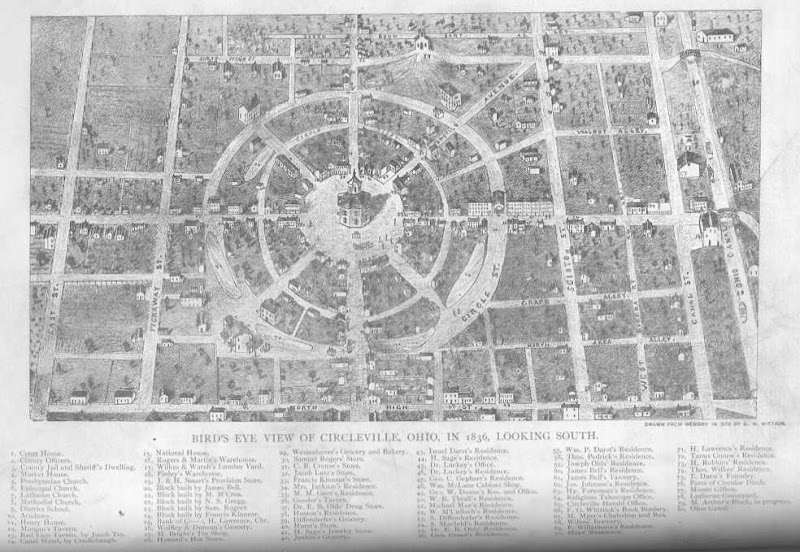
Circleville, Ohio

From rootsweb.com


From top to bottom, Circleville in 1811, 1837, 1838, 1849, and 1856

Daniel Driesback laid out this circular town with radiating avenues in 1810. It was based on a circular mound that had been built by Indians before the city was built. In the centre plaza, on top of the mound, was an octagonal courthouse. Outside the circle though was a grid.

But he grid eventually overtook the circular centre.
By the time James Silk Buckingham visited the site in 1840, he wrote:
“So little veneration …have the Americans for ancient remains…that this interesting spot of Circleville, is soon likely to lose all traces of its original peculiarities. The circular streets are fast giving way, to make room for straight ones; and the central edifice itself is already destined to be removed, to give place to stores and dwellings; so that in century or less, there will be no vestige left of that peculiarity which gave the place its name, and which constituted the most perfect and therefore the most interesting work in antiquity of its class in the century”

In fact it took only about 50 years.


References:

  • Spiro Kostof, The City Shaped, 1991
  • Quote from J.S. Buckingham, “The Eastern and Western states of America”, 1842, quoted in Spiro Kostof, The City Shaped, 1991, pp 162

Related Posts:

Subscribe to Tessellar Blog
and get a FREE E-Book
HONEYCOMB HOUSING
An Affordable Alternative to Terrace Housing


17MB, 49 A4 pages, 57 illustrations


Social Bookmarking

Add to: Digg Add to: Del.icio.us Add to: Reddit Add to: StumbleUpon Add to: Yahoo Add to: Google Add to: Technorati Information

Wednesday, November 14, 2007

The Round City of Baghdad #2


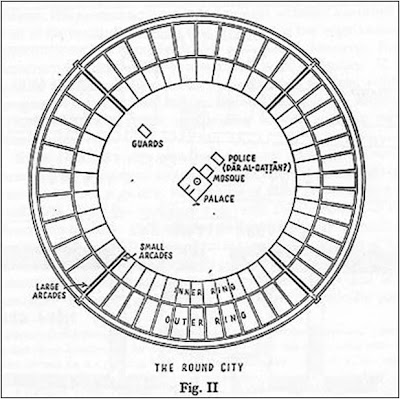
Plan

The Round City of Baghdad was also called Madinat-As-Salam: the City of Peace.

A round city wall was both cheaper to build for a given area and easier to defend. To improve the defenses were bent entrances and the double wall.


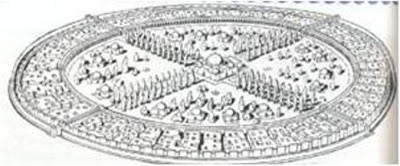
Artist's Impression

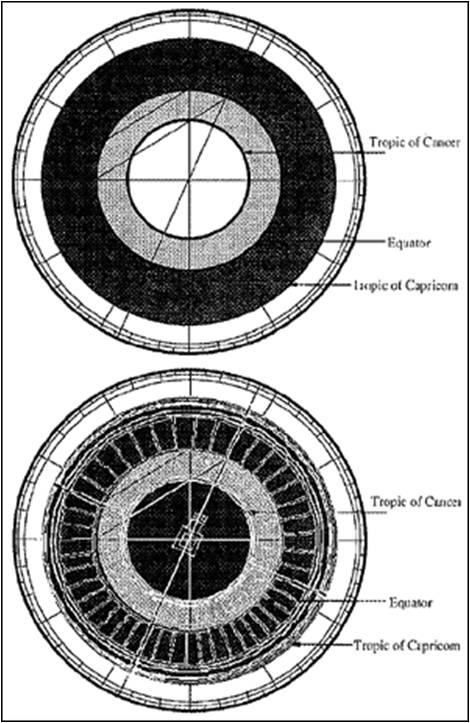
But the circular arrangement of streets and gates was also also tonreflect the orbit of planets,and the central position of the palace and mosque reflects the sun as the center of universe.

As it turned out, the history of Baghdad did not turn out to be so peaceful.


Islamic understanding of the shape of the earth

From 836 to 892 the capital was transferred to Samarra because of troubles with the caliph's Turkish troops in Baghdad. When Caliph al-Mu'tamid moved back to Baghdad he settled on the east bank of the Tigris which has remained the centre of the city to the present day.

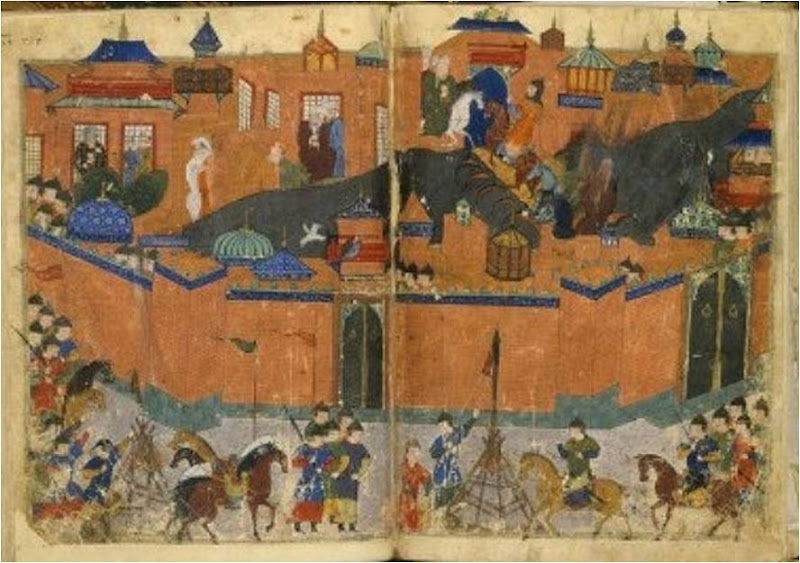
In 1258 Hulagu Khan, a grandson of Genghis Khan captured, sacked, and burned Baghdad.


The Grand Library of Baghdad was destroyed. The Tigris ran black with ink from the enormous quantities of books flung into the river.


Hulagu’s Mongol army at Baghdad from wikimedia

The Mongols looted and then burnt mosques, palaces, libraries, and hospitals to the ground.

Estimates of people massacred range from 90,000 to 200,000. Hulagu had to move his camp upwind of the city, due to the stench of decay from the ruined city.

The Mongols rolled the caliph up in a rug, and rode their horses over him.

The destruction of Baghdad was to some extent a military tactic: it was supposed to convince other cities and rulers to surrender without a fight. But failed in Egypt, which defeated the Mongols at the Battle of Ain Jalut in 1260.


References:


Related Posts:

Subscribe to Tessellar Blog
and get a FREE E-Book
HONEYCOMB HOUSING
An Affordable Alternative to Terrace Housing


52 MB, 49 A4 pages, 57 illustrations


Social Bookmarking


Add to: Digg Add to: Del.icio.us Add to: Reddit Add to: StumbleUpon Add to: Yahoo Add to: Google Add to: Technorati Information

Sunday, November 11, 2007

The Round City of Baghdad

In 754, al-Mansur became the second Abbasid Caliph who commissioned the construction of a new capital - Baghdad.

During al-Mansur's reign there was a rapprochement between that Persians and Arabs. Persian literature and scholarship became appreciated in the Islamic world.

Photo Sharing and Video Hosting at Photobucket
Plan of the Round City of Baghdad, from www.faculty.fairfield.edu

Baghdad’s round plan found Persian precedents such as Ectabana, Hatra and Firouzabad. According to Manouchehr Saadat Noury (Persian Journal, 2005) two designers who were hired by Mansur to plan the city's design were two Iranians named Naubakht-e-Parsi, a former Persian Zoroastrian, and Mashallah-e-Assiri, a former Jew from Khorassan (a northeastern province in present-day Iran).

The city was designed with ash drawings onto the ground for al-Mansur to view prior to construction, which began that same year. By its completion in 766-7, it has been posited that the Round City measured 2000 meters in diameter.

It featured four main gates, equidistant from each other: the southwest gate was the Kufa Gate; the southeast was Basra; the Khurasan Gate extended to the northeast and the Damascus Gate to the northwest. The walls were constructed out of mud brick with reed supports, while the domes and vaults were composed in baked brick.

References: www.faculty.fairfield.edu,
Manouchehr Saadat Noury

Related Post:


Enter your Email


Preview | Powered by FeedBlitz

Subscribe in a reader


Social Bookmarking

Add to: Digg Add to: Del.icio.us Add to: Reddit Add to: StumbleUpon Add to: Yahoo Add to: Google Add to: Technorati Information